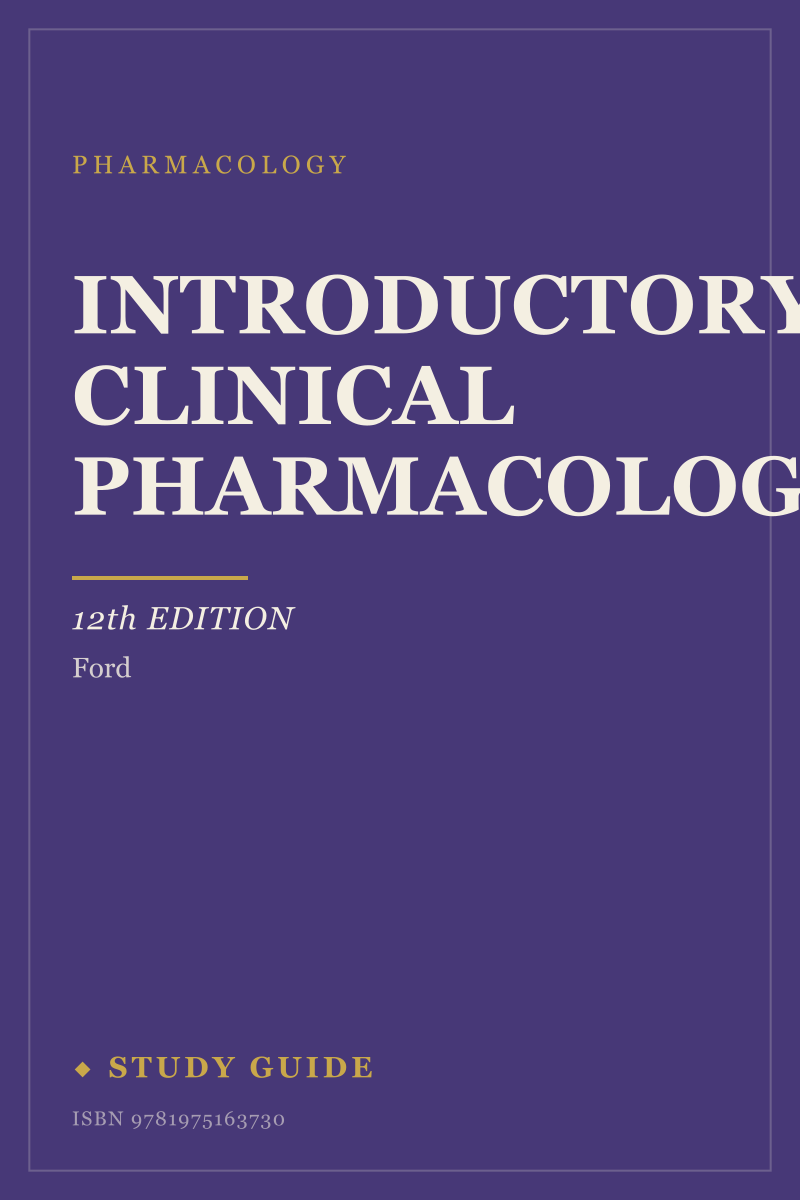
Introductory Clinical Pharmacology
Ford · 12th Edition
Complete chapter-by-chapter study guide aligned with Introductory Clinical Pharmacology (12th Edition). Includes summaries, learning objectives, and NCLEX-style practice questions for all 54 chapters.
Overview
Ford's Introductory Clinical Pharmacology (12th Edition) is one of the most widely used pharmacology texts in practical and undergraduate nursing programs, and it moves through a large amount of drug content fast. This study guide is built to match it chapter for chapter, so you study in the same order your professor teaches — from general principles of pharmacology, drug administration, and the nursing process through the major drug classes: antibacterials, antivirals and antifungals, analgesics, CNS and psychiatric drugs, adrenergic and cholinergic agents, cardiovascular and respiratory drugs, diuretics, and antidiabetic medications. You get the priority drug actions, key adverse effects, nursing implications, and patient-teaching points, plus NCLEX-style practice that mirrors how pharmacology is actually tested — without re-reading the whole book. It is an independent, aligned study aid, not the textbook itself and not a copy of it.
Aligned with practical and undergraduate nursing pharmacology courses and written in an NCLEX-style, mirroring how drug classes, adverse effects, and nursing implications are tested on course exams and the licensure exam.
What you'll learn
The major topics this guide walks you through, matched to the textbook's order:
- General principles of pharmacology
- Safe drug administration and dosing
- The nursing process in pharmacology
- Antibacterial and sulfonamide drugs
- Antiviral and antifungal drugs
- Opioid and nonopioid analgesics
- Antianxiety and antidepressant drugs
- Adrenergic and cholinergic drugs
- Antihypertensive drugs
- Anticoagulant and thrombolytic drugs
- Diuretics and cardiac drugs
- Respiratory system drugs
- Gastrointestinal drugs
- Antidiabetic drugs
Chapters covered
Every chapter below is fully covered in the PDF — summary, learning objectives, key terms, and NCLEX-style practice questions with rationales.
Questions about this study guide
What exactly do I get?
A printable PDF study guide covering all 54 chapters of Introductory Clinical Pharmacology (12th Edition) — chapter summaries, learning objectives, and NCLEX-style practice questions with rationales. One file, lifetime access, no subscription.
How soon will I get it?
Instantly. A download link appears on screen and lands in your inbox the moment your payment clears.
Is this guide based on the 12th Edition?
Yes, it follows the 12th Edition chapter order and drug-class organization used in your course.
Does it use NCLEX-style questions?
Yes. The practice mirrors NCLEX-style pharmacology items focused on drug actions, adverse effects, and nursing implications.
Can I use this instead of reading the textbook?
It is a review tool that condenses high-yield content; it works best alongside the textbook rather than as a full replacement.
Will it match my edition?
This guide is built around the 12th Edition. If your class uses a different edition, chapter numbering may shift slightly, but the topics and learning objectives are usually unchanged.
Do I still need the textbook?
The study guide is a companion, not a replacement — it helps you study efficiently and review fast, but you'll still want the textbook for full depth and any assigned readings.
What if it is not what I expected?
Every purchase is backed by a 14-day money-back guarantee — email us within 14 days for a full refund.
Is this a test bank or copied from the textbook?
No. This is an original study guide written to align with Introductory Clinical Pharmacology — summaries, objectives, and practice questions with rationales, not a reproduced publisher test bank or copied text.
More nursing study guides
About this study guide
This is an original study guide written to align with the topics and learning objectives covered in Introductory Clinical Pharmacology (12th Edition) by Ford. It is not affiliated with, endorsed by, or licensed by the publisher or the textbook's authors. All summaries, practice questions, and explanations are independently authored.