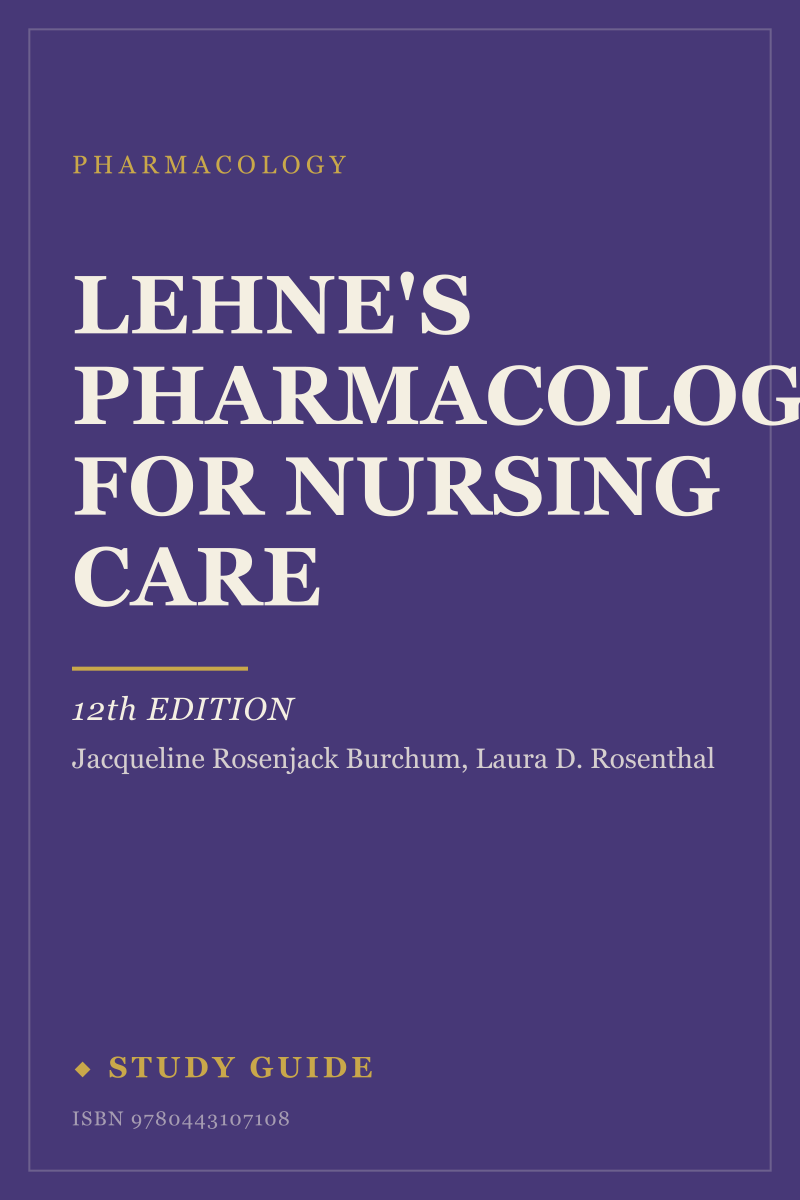
Jacqueline Rosenjack Burchum, Laura D. Rosenthal · 12th Edition
Complete chapter-by-chapter study guide aligned with Lehne's Pharmacology for Nursing Care (12th Edition).
Includes summaries, learning objectives, and NCLEX-style practice questions for all 113 chapters.
Overview
Lehne's Pharmacology for Nursing Care (12th Edition) is one of the most respected pharmacology texts in nursing education, and it covers an enormous amount of drug content with a focus on the reasoning behind safe administration. It builds from the foundations — pharmacokinetics, pharmacodynamics, drug interactions, adverse reactions, and individual variation — into the major drug classes, including the peripheral and central nervous system agents, drugs for neurologic and psychiatric disorders, pain management, and special populations such as pregnant patients, children, and older adults. This study guide is built to match the textbook chapter for chapter, so you study in the same order your professor teaches and can tie each drug class to the nursing implications that matter at the bedside. It is an independent, aligned study guide — not the textbook and not a reproduction of it — designed to highlight the prototype drugs, mechanisms, key nursing considerations, and NCLEX-style practice that mirror how pharmacology is actually tested, so you can review high-yield material for exams without re-reading the whole book.
Aligned with undergraduate nursing pharmacology courses and written in an NCLEX-RN style — the practice questions and rationales mirror how pharmacology is tested on course exams and the licensure exam.
What you'll learn
The major topics this guide walks you through, matched to the textbook's order:
Pharmacokinetics and pharmacodynamics
Adverse drug reactions and errors
Drug interactions and variation
Autonomic nervous system drugs
Adrenergic and cholinergic agents
Drugs for Parkinson and Alzheimer disease
Antiseizure medications
Opioid and nonopioid analgesics
Antipsychotics and antidepressants
Sedative-hypnotics and anxiety drugs
Drug therapy in special populations
Local and general anesthetics
Drugs for bipolar disorder
CNS stimulants and ADHD
Need the textbook itself?
Authored by Jacqueline Rosenjack Burchum and Laura D. Rosenthal and published by Elsevier, Lehne's Pharmacology for Nursing Care is known for explaining drug mechanisms and nursing implications clearly and is a standard text in many BSN and ADN programs.
Buy new, rent, or find a used copy of Lehne's Pharmacology for Nursing Care below. Make sure you get the 12th Edition — editions differ, so double-check the ISBN on the listing before you order.
We earn a small commission if you buy through these links — your price is unchanged.
Every chapter below is fully covered in the PDF — summary, learning objectives, key terms, and NCLEX-style practice questions with rationales.
Thinking about RN-to-BSN or MSN?
Compare accredited online nursing programs (CCNE-accredited, NCLEX pass rate published) in under a minute. Most students get a tuition estimate the same day.
Your employer's coverage doesn't fully protect you. A personal RN policy from NSO runs about $100/year and is what most nursing boards recommend on day one.
A printable PDF study guide covering all 113 chapters of Lehne's Pharmacology for Nursing Care (12th Edition) — chapter summaries, learning objectives, and NCLEX-style practice questions with rationales. One file, lifetime access, no subscription.
How soon will I get it?+
Instantly. A download link appears on screen and lands in your inbox the moment your payment clears.
Does this match the 12th Edition of Lehne?+
Yes. It is organized to follow the 12th Edition chapter by chapter, including the drug-class chapters in the same sequence.
Is pharmacology heavy on the NCLEX, and does this prepare for it?+
Pharmacology is one of the most heavily tested areas on the NCLEX-RN. The questions here are written in NCLEX style to build the drug-reasoning skills the exam expects.
Will this help me memorize the prototype drugs?+
It focuses on the prototype drugs and their key nursing considerations for each class, which is the most efficient way to study pharmacology for exams.
Will it match my edition?+
This guide is built around the 12th Edition. If your class uses a different edition, chapter numbering may shift slightly, but the topics and learning objectives are usually unchanged.
Do I still need the textbook?+
The study guide is a companion, not a replacement — it helps you study efficiently and review fast, but you'll still want the textbook for full depth and any assigned readings. You can buy new, rent, or find a used copy through the price links on this page.
What if it is not what I expected?+
Every purchase is backed by a 14-day money-back guarantee — email us within 14 days for a full refund.
Is this a test bank or copied from the textbook?+
No. This is an original study guide written to align with Lehne's Pharmacology for Nursing Care — summaries, objectives, and practice questions with rationales, not a reproduced publisher test bank or copied text.
This is an original study guide written to align with the topics and learning objectives covered in Lehne's Pharmacology for Nursing Care (12th Edition) by Jacqueline Rosenjack Burchum, Laura D. Rosenthal. It is not affiliated with, endorsed by, or licensed by the publisher or the textbook's authors. All summaries, practice questions, and explanations are independently authored.